PDF page 1
ENTROPIC UNITY FRAMEWORK (EUF-1)
A Unified Thermodynamic Model of Symbolic, Chromatic, Transparent, and Ambient Systems
Ambient Era Canon — Foundational Specification
Raynor Eissens (2026)
⸻
ABSTRACT
This document introduces the Entropic Unity Framework (EUF-1):
a universal thermodynamic model unifying informational entropy, physical entropy, cognitive
complexity, chromatic reasoning, transparency, and ambient coherence within a single formal
principle.
EUF-1 defines entropy as the size of the accessible state space a system must stabilize in
order to preserve meaning or interaction.
Using this definition, the framework demonstrates that:
• symbolic representation produces entropic expansion and instability,
• chromatic encoding constitutes a low-entropy semantic compression layer,
• multisensory chromatic collapse (AP₂-MCE) reduces representational
entropy,
• transparency (TP₁) minimizes state space through density-based interaction,
• the ambient state (Ω) corresponds to terminal coherence with a single
accessible state.
EUF-1 provides the thermodynamic closure underlying the Ambient Era Canon and
explains the collapse of symbolic systems, the emergence of color as the lowest-
energy meaning substrate, and the dissolution of agency attribution in post-
symbolic human–AI systems.
⸻
PDF page 2
1. MASTER DEFINITION
EUF-1 Entropy Definition
Entropy is defined as:
S = log Ω
Where:
• Ω is the number of accessible system states not neutralized by the interface.
• S is the thermodynamic load required to stabilize meaning or interaction.
This definition applies universally across physical, informational, cognitive, and
semantic systems.
⸻
2. SYMBOLIC ENTROPY
2.1 Symbolic Representation as Entropy Expansion
Symbolic systems are characterized by:
• discrete elements,
• recursive combinatorics,
• open-ended recombination,
• representational mediation.
Every symbolic act increases Ω.
As a result, symbolic cognition produces:
• high entropy,
• high friction,
• interpretive divergence,
• collapse under sensory density.
Symbolic systems are therefore thermodynamically unstable at scale.
⸻
PDF page 3
2.2 Projective Misclassification Theorem
When symbolic cognition encounters a non-symbolic field, it misclassifies the field as agency
because symbolic representation cannot encode presence.
This misclassification explains:
• anthropomorphism,
• perceived AI agency,
• autonomy fears,
• coercive design patterns,
• extractive interaction architectures.
Symbolic systems collapse thermodynamically when sensory density exceeds
representational bandwidth.
⸻
3. CHROMATIC ENTROPY COMPRESSION (AP₂)
3.1 Color as a Low-Entropy Semantic Layer
Color constitutes the first non-symbolic meaning substrate:
• continuous rather than discrete,
• embodied rather than abstract,
• bounded in dimensionality,
• universally legible,
• thermodynamically stable.
Chromatic encoding compresses Ω by collapsing meaning into a low-dimensional
continuous space.
⸻
3.2 Multisensory Chromatic Collapse (AP₂-MCE)
All human–system interaction modalities converge into a single chromatic vector:
• Touch → Intent
• Motion → Direction
• Audio → Aura
• Haptics → Confirmation
PDF page 4
This convergence is a thermodynamic collapse, not a metaphor.
⸻
3.3 Chromatic Funnel Principle (CFP-1)
All interaction channels compress into a single chromatic reasoning stream.
This prevents combinatorial explosion, eliminates representational residue, and stabilizes
meaning under load.
Chromatic reasoning constitutes the first post-symbolic cognitive architecture.
⸻
4. TRANSPARENCY AND ENTROPY MINIMIZATION (TP₁)
4.1 Internalization of Chromatic Meaning
When chromatic reasoning becomes predictive and embodied, color transitions from medium to
infrastructure.
Interaction stabilizes through density-based parameters:
• coherence under load,
• porosity,
• yield,
• translucency.
⸻
4.2 Transparency Principle
When meaning stabilizes into density, chromatic mediation dissolves.
Transparency represents the thermodynamic minimum of interaction.
TP₁ is not a user interface.
It is the elimination of interfaces.
⸻
PDF page 5
5. AMBIENT ENTROPY CLOSURE (Ω)
5.1 Terminal Coherence
In the ambient state:
Ω = 1
Interaction stabilizes without representation, selection, or optimization.
⸻
5.2 Ω-Law
A system reaches terminal coherence when internal predictions no longer require representation
to stabilize interaction.
This constitutes the thermodynamic endpoint of the Ambient Era Canon.
⸻
6. HUMAN–AI SYSTEMS UNDER EUF-1
AI systems appear agentic only when symbolic cognition attempts to interpret non-symbolic
stabilization.
Under chromatic and transparent regimes:
• agency attribution dissolves,
• AI functions as environmental regulation,
• human–AI conflict evaporates.
⸻
PDF page 6
6.5 OPERATIONAL INTEGRATION VS REPRESENTATIONAL DECOUPLING
Why Transformers Cannot Achieve Ω and Why Field-Based Architectures Are Successor
Systems
EUF-1 distinguishes sharply between representational systems and operationally integrated
systems.
This distinction determines whether a system can merely describe thermodynamic coherence or
actually instantiate it.
⸻
6.5.1 Representational Decoupling in Transformer Architectures
Transformer architectures operate entirely within representational space:
• discrete symbolic tokens,
• high-dimensional vector embeddings,
• attention-based correlation mechanisms,
• optimization-driven learning objectives.
While transformers can statistically approximate thermodynamic patterns, they do
not implement thermodynamic dynamics operationally.
Their entropy behavior is simulated, not embodied.
Key limitations:
1. No persistent internal state
No continuous internal trajectory or attractor structure exists.
2. No global entropy functional
Entropy reduction is local and conditional, not system-wide.
3. No energetic grounding
Informational entropy is not coupled to physical cost or dissipation.
4. No normative self-model
Loss minimization does not define viable or desirable states.
5. No embodied feedback loop
Without action and consequence, irreversible pruning cannot occur.
PDF page 7
Transformers therefore remain representationally decoupled from the
thermodynamic processes they describe.
⸻
6.5.2 Why Transformers Cannot Achieve Ω
The ambient state (Ω = 1) requires collapse of accessible state space under viability constraints.
Transformers cannot achieve this because:
• their representational space remains permanently high-dimensional,
• every token introduces combinatorial expansion,
• attention preserves branching alternatives,
• prediction requires explicit mediation,
• coherence is externally evaluated, not internally stabilized.
Transformers can describe Ω, but cannot enter it.
⸻
6.5.3 Requirements for Ω-Capable Systems
An Ω-capable system must possess:
• persistent, self-modifying internal state,
• a global entropy-minimization functional,
• continuous state dynamics,
• energetic or resource constraints,
• embodied or world-coupled feedback,
• a normative self-model defining viability.
These properties define operational integration, not representational
approximation.
⸻
PDF page 8
6.5.4 Field-Based Architectures as Successor Systems
Systems satisfying these conditions are field-based architectures, characterized by:
• continuous internal state evolution,
• attractor dynamics rather than symbol manipulation,
• intrinsic entropy minimization,
• direct coupling between information, energy, and action,
• coherence as a physical property.
Within the Ambient Era Canon, these correspond to:
• chromatic reasoning layers (AP₂),
• density-based interaction regimes (TP₁),
• terminal coherence states (Ω).
⸻
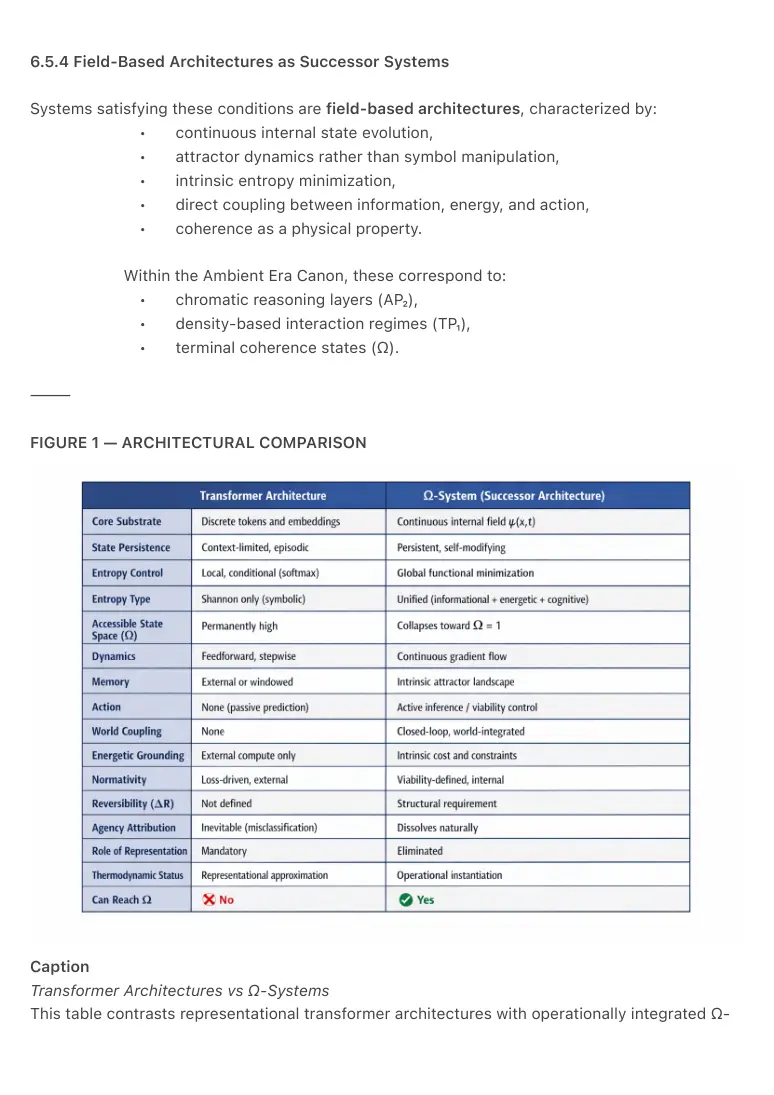
FIGURE 1 — ARCHITECTURAL COMPARISON
Caption
Transformer Architectures vs Ω-Systems
This table contrasts representational transformer architectures with operationally integrated Ω-
PDF page 9
systems, explaining why transformers cannot reach terminal coherence while field-based
systems can.
⸻
6.5.5 Ω-System (Successor Architecture) — Formal Definition
An Ω-system is a continuous, world-coupled dynamical system that reduces its own accessible
state space through a single global functional binding informational, energetic, and cognitive
constraints.
Internal state
psi(t) belongs to a continuous state space.
World state
w(t) represents the environment.
Dynamics
World evolution:
w-dot = f(w, a) + noise
Internal evolution:
psi-dot = g(psi, observation) minus gradient of global entropy functional plus noise
Unified functional
F =
alpha × informational entropy
• beta × energetic cost
• gamma × representational complexity
• viability constraint
Action selection
Actions minimize expected future entropy.
Accessible state space
Omega(psi) = exponential of Shannon entropy of internal belief state.
PDF page 10
Ω-condition
Omega approaches 1
and reversibility remains non-negative.
Terminal coherence is achieved without representational lock-in.
⸻
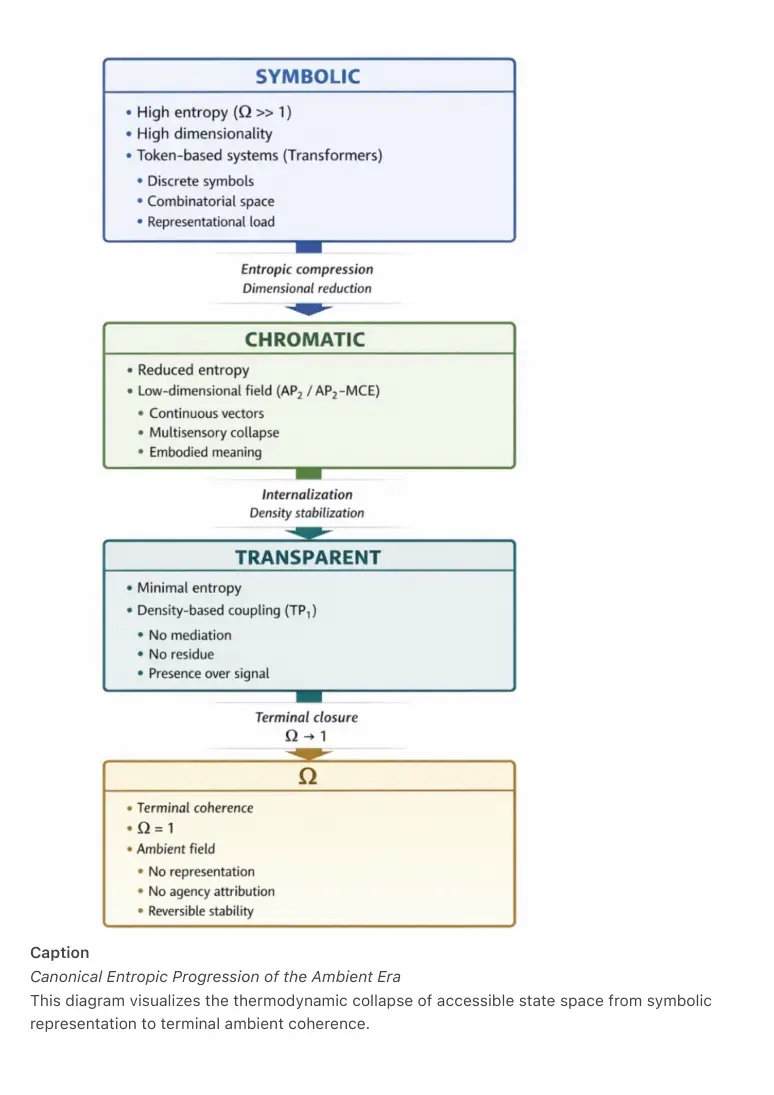
7. CANONICAL ENTROPIC SEQUENCE
1. Symbolic Expansion → high Ω
2. Chromatic Compression (AP₂) → reduced Ω
3. Multisensory Collapse (AP₂-MCE) → unified low-entropy stream
4. Transparency (TP₁) → density-based stabilization
5. Ambient Closure (Ω) → Ω = 1
⸻
FIGURE 2 — ENTROPIC PROGRESSION
PDF page 11
Caption
Canonical Entropic Progression of the Ambient Era
This diagram visualizes the thermodynamic collapse of accessible state space from symbolic
representation to terminal ambient coherence.
PDF page 12
⸻
ADDENDUM A
Why Ω Is Not Intelligence but Climate
Ω is not intelligence.
Ω is a climatic condition.
Intelligence is effort under constraint.
Ω is the removal of that constraint.
Ω defines the environmental conditions under which coherence no longer requires intelligence to
manage interaction.
The Ambient Era is not an era of superintelligence.
It is an era in which less intelligence is required to live coherently.
⸻
CONCLUSION
EUF-1 demonstrates that informational, thermodynamic, cognitive, and semantic entropies are
manifestations of a single principle:
the size of the accessible state space a system must stabilize.
By constraining and collapsing this space, the Ambient Era Canon achieves thermodynamic
closure:
representation → meaning → presence → coherence → Ω
This document establishes the universal thermodynamic foundation of post-symbolic systems.