PDF page 1
Chromatic Message-to-Route (AEC-CMR1)
How State-First Color Communication Transforms into Navigation, Temporary Residue, Agent
Legibility, and Ambient Coordination
From Message to Movement in the Ambient Era
Ambient Era Canon
Raynor Eissens
DOI: 10.5281/zenodo.19144415
⸻
Abstract
This paper introduces Chromatic Message-to-Route, a state-first communication model in
which a chromatic message does not disappear after being received, but may transform into
movement, navigation, attractor activation, temporary residue, and, more broadly, ambient
coordination. Instead of treating communication, routing, and memory as separate layers, this
model proposes a continuous chromatic chain: a message can first appear as a glanceable state-
sequence, then become a route, then briefly persist as contextual residue, and later dissolve
when the situation has ended.
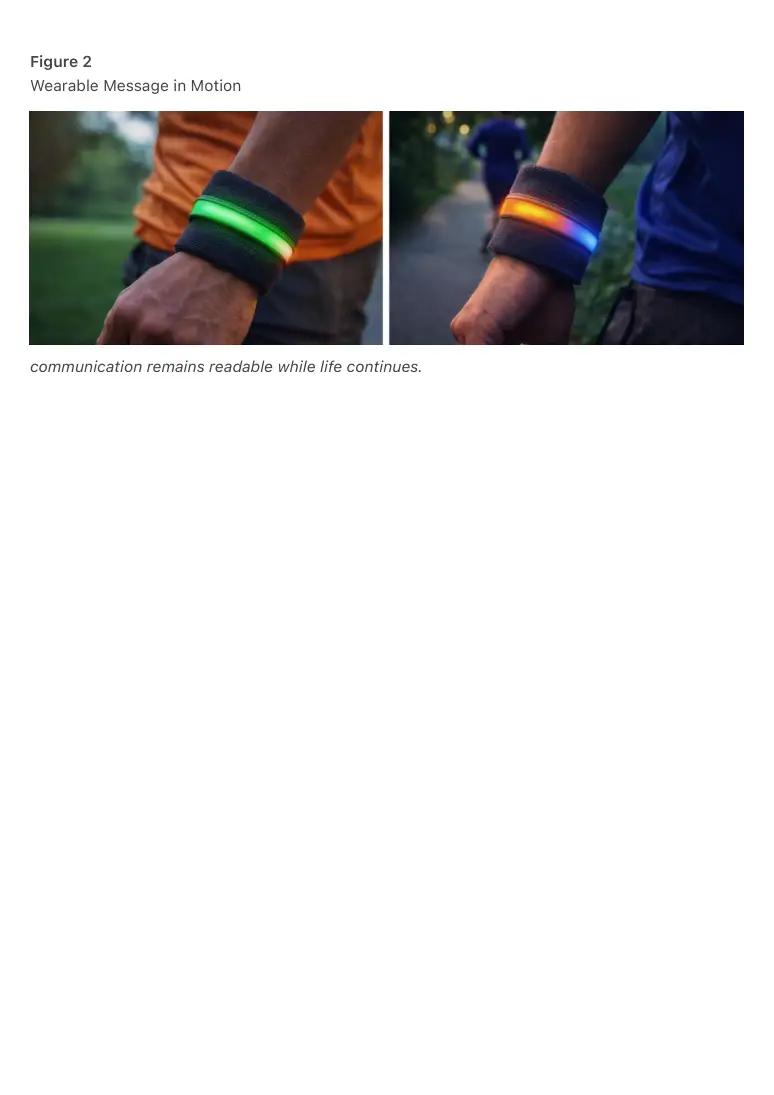
The paper argues that this transition is especially important for life in motion: running, cycling,
walking, commuting, care, public coordination, and other situations where textual interaction is
too heavy or too slow. In these contexts, color functions not as decoration, but as a lightweight
state-bearing medium that remains readable while life continues.
This model extends Chromatic Reasoning beyond messaging as a bounded app function. It
proposes a broader ambient communication substrate in which color can operate across
wearables, objects, navigation systems, animal collars, keyfobs, household strips, and
infrastructure surfaces. Once accepted, a chromatic message may collapse into route-guidance,
build temporary residue through traversal, and then disappear again without leaving symbolic
burden behind.
The same chromatic logic also scales into distributed AI systems. As multi-agent architectures
become more common, color can function as a legibility layer for affiliation, role, pressure,
handoff, resonance, and completion, making humans, agents, animals, and infrastructure
readable through one shared ambient grammar. Contemporary xAI documentation already
describes multi-agent research as coordinated work among multiple specialized agents, which
makes this extension practical rather than hypothetical.
PDF page 2
⸻
Zenodo description
Type: Project Milestone
Language: English
License: CC BY-SA 4.0
Keywords: chromatic communication, ambient computing, wearable communication, state-first
interface, navigation residue, attractor systems, first-glance communication, ambient running,
chromatic wearables, route residue, field communication, low-symbolic interface, multi-agent
legibility, chromatic grouping, AEC-CMR1, Ambient Running Protocol, zenodo.18626577,
message-to-movement
⸻
PDF page 3
Position in the Ambient Era Canon
(AEC-CMR1 — Chromatic Message-to-Route, 1.0)
This paper constitutes the first explicit operationalisation of the message-to-movement
continuity within the Ambient Era Canon. It extends and completes several prior contributions:
●
●
●
●
●
●
Ambient Era Canon — Complete Structural Edition (Eissens, R., 2026, DOI: 10.5281/ zenodo.18343081, ambientphone.com/ambient-canon) — as the overarching ontological frame that unifies agentic, spatial and ambient layers, of which this paper supplies the operational chromatic grammar. Ambient Running Protocol™ (Eissens, R., 2026, DOI: 10.5281/zenodo.18626577, ambientrunning.com) — by turning the motion-first, “no maps, no arrows, chromatic run completed” field into the concrete testbed where a chromatic message directly becomes route + residue without textual interruption. Route Residue as the Origin of Transparent Spatiality (Eissens, R., 2026, DOI: 10.5281/ zenodo.18798921) and the full Residue Canon (RR₁–RR₁₀) — by making residue not only the thermodynamic remainder of traversal but the direct, reversible successor of an accepted chromatic message. TSX-5 — Universal Chromatic Reconstruction (DOI: 10.5281/zenodo.18779649) and CE-2 — Chromatic Encoding (DOI: 10.5281/zenodo.18763518) — by turning the chromatic field into a grammatical, sentence-structured, portable medium that survives the transition from message to route to residue. Generative Depth and Chromatic Front (Eissens, R., 2026, DOI: 10.5281/ zenodo.18943684) and Spontaneous Chromatic Reasoning (DOI: 10.5281/ zenodo.18740444) — by applying the humane semantic layer to life-in-motion (running, cycling, care, public coordination) and to distributed multi-agent orchestration. The broader Thermodynamic Semiotics stack (TSX-0 → TSX-5) and the Raynor Stack infrastructure principles — by demonstrating that chromatic communication is the first- glance, low-symbolic, reversible substrate that makes agentic + spatial + ambient computing simultaneously legible and non-capturing.
Where earlier canon papers established residue as thermodynamic memory, chromatic
encoding as continuous field, Chromatic Front as humane upper layer, and the Ambient
Running Protocol as the living motion substrate, AEC-CMR1 now supplies the missing
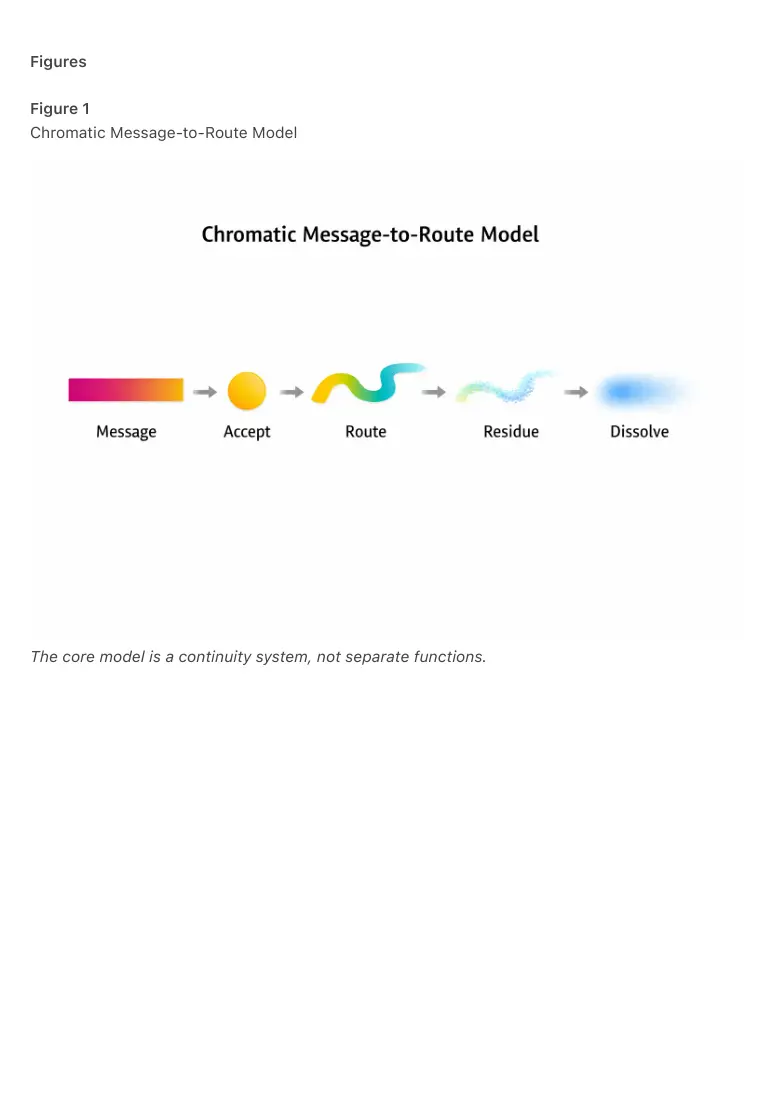
operational grammar: the continuous chain message → accept → route → residue → dissolve.
It thereby closes the loop between bounded messaging and ambient coordination, and between
human motion and multi-agent legibility, under one shared chromatic medium.
This positions Chromatic Message-to-Route as a transitional bridge paper: the first full
translation of the canon’s theoretical substrate (anchored at ambientphone.com and
ambientera.org) into a deployable, glanceable, object-agnostic, and ethically reversible system
ready for wearables, infrastructure, animal collars, household surfaces, and real-time xAI-style
agent ecologies.
⸻
PDF page 4
1. Introduction
Contemporary computing is increasingly described through three emerging directions: agentic,
spatial, and ambient. Agentic systems distribute action across agents and tools. Spatial systems
distribute interface and computation across space, surfaces, and embodied context. Ambient
systems distribute continuity, allowing support to remain present without demanding constant
symbolic attention. This paper argues that color provides a missing first-glance legibility layer
across all three: it can make action, orientation, and continuity readable before text.
Communication, navigation, and memory are usually treated as separate technical layers. A
message is sent through one interface, a route is generated through another, and memory is
stored somewhere else as symbolic residue. This split is functional, but not humane. In life, these
processes often belong to the same flow.
A person may receive a proposal, decide to move, follow a route, form a temporary habit, and
then forget it once the situation ends. Current systems usually break this sequence into
fragments: message first, route second, memory later. The result is friction, over-symbolization,
and unnecessary residue.
This paper proposes a different model:
a chromatic message can become a route, and a route can become residue.
In this framework, communication does not vanish after reception. It may transform into
movement. If the message is accepted, the same chromatic structure may become directional
guidance, then build temporary traversal-strength, and then disappear when the context no
longer matters. Communication is therefore not only exchanged. It is carried into life.
This is especially relevant in motion: running, cycling, walking, commuting, care work, public
movement, and social coordination. In such conditions, textual reading is often too slow, too
fragile, or too disruptive. Color, by contrast, can remain glanceable, ambient, and state-bearing
while the body continues moving.
⸻
PDF page 5
2. Core claim
The core claim of this paper is simple:
A state-first chromatic message can transform into movement, navigation, and temporary
residue without ever needing to become a full symbolic burden.
This implies a continuity model:
message → route → residue → dissolve
The same chromatic sequence may appear in different operational phases:
• first as a message
• then as a directional cue
• then as a strengthened attractor or route-memory
• then as a fading contextual trace
• finally as disappearance
In other words:
communication does not disappear. It transforms into movement.
⸻
3. Why text is too heavy for life in motion
Most messaging assumes a paused subject. The user is expected to stop, read, interpret, type,
and reply. This works in stationary situations, but not well in motion.
While running, cycling, walking, shopping, caring for animals, commuting, or moving through
public space, the user is already occupied by:
• body state
• route state
• social awareness
• environmental conditions
• safety thresholds
• timing and coordination
In such contexts, text competes with life.
Color does not.
PDF page 6
Color can remain:
• state-first
• glanceable
• low-pressure
• fast
• body-compatible
• distributable across multiple surfaces
This makes color a uniquely suitable medium for communication-in-motion.
⸻
4. Chromatic sentence structure
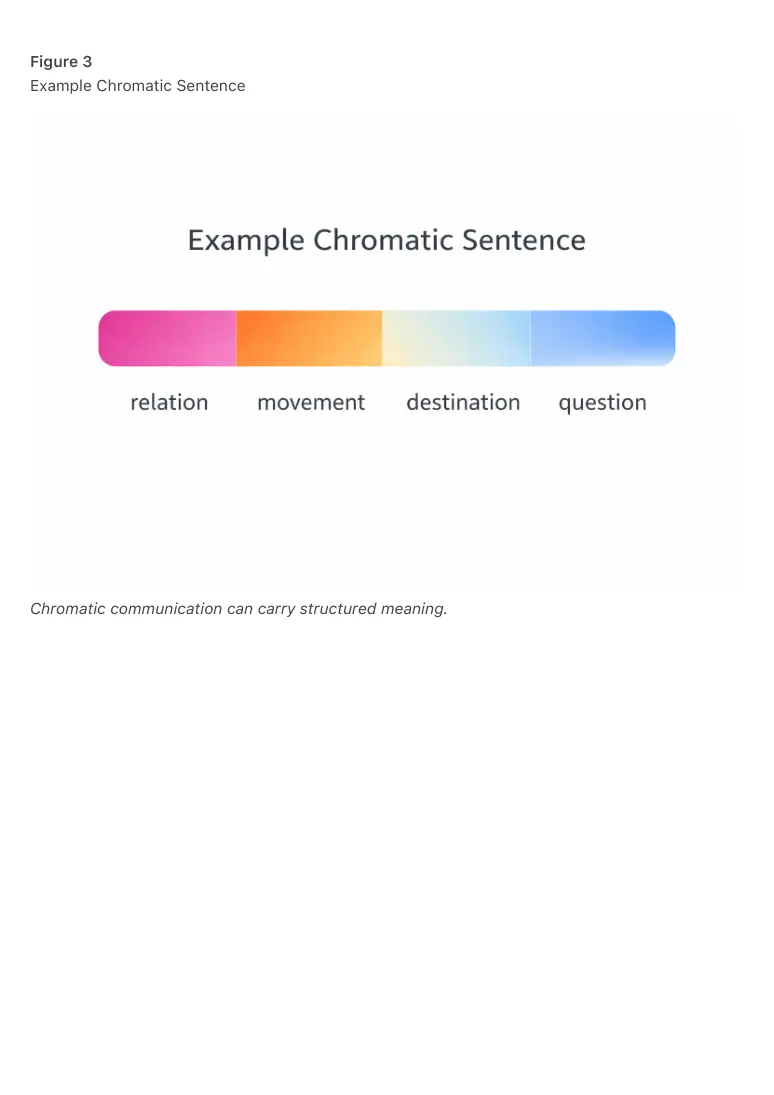
A chromatic message is not merely one color. It is a structured sequence.
A minimal chromatic sentence may include:
4.1 Relation prefix
Who is speaking in relational terms.
Example: pink.
4.2 Action or motion segment
What is being proposed, done, or triggered.
Example: yellow or orange.
4.3 Entity or destination gradient
What place, object, animal, or context is involved.
Examples:
• beach = beige + light blue
• forest = pine green
• city = gray + purple
• dog = red + green
• book = blue + purple
PDF page 7
4.4 Terminal mood
How the message ends.
Examples:
• blue fade = question
• green landing = agreement / positive state
• red ending = problem / urgency / negative state
• gray dissolve = uncertainty / later / soft suspension
• orange lift = invitation / desire / activation
A message such as:
“Shall we go to the beach?”
may therefore become:
pink → orange/yellow → beach gradient → blue fade
This can be understood at first glance without reading a sentence.
⸻
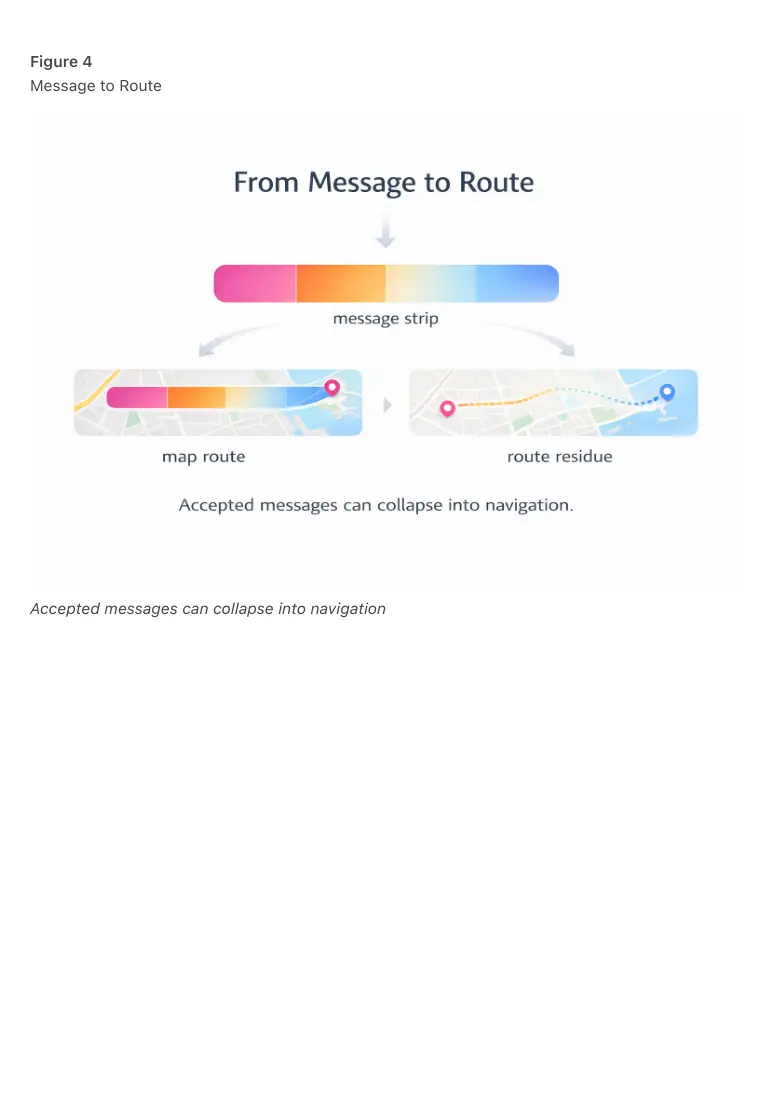
5. From message to route
The key innovation appears after acceptance.
Once a user accepts a message, the chromatic message does not need to vanish. The same
sequence can collapse into navigational form.
Example:
• incoming message: pink → yellow → beach gradient → blue fade
• user accepts
• the beach gradient becomes a route attractor
• the yellow motion segment becomes directional guidance
• the message now lives as movement rather than as conversation
This means:
• a message can become a route on a map
• a message can become a directional strip on a wearable
• a message can become a temporary attractor in a mobility system
PDF page 8
So the system does not force a second symbolic translation.
The communication itself becomes locomotion.
6. Residue after traversal
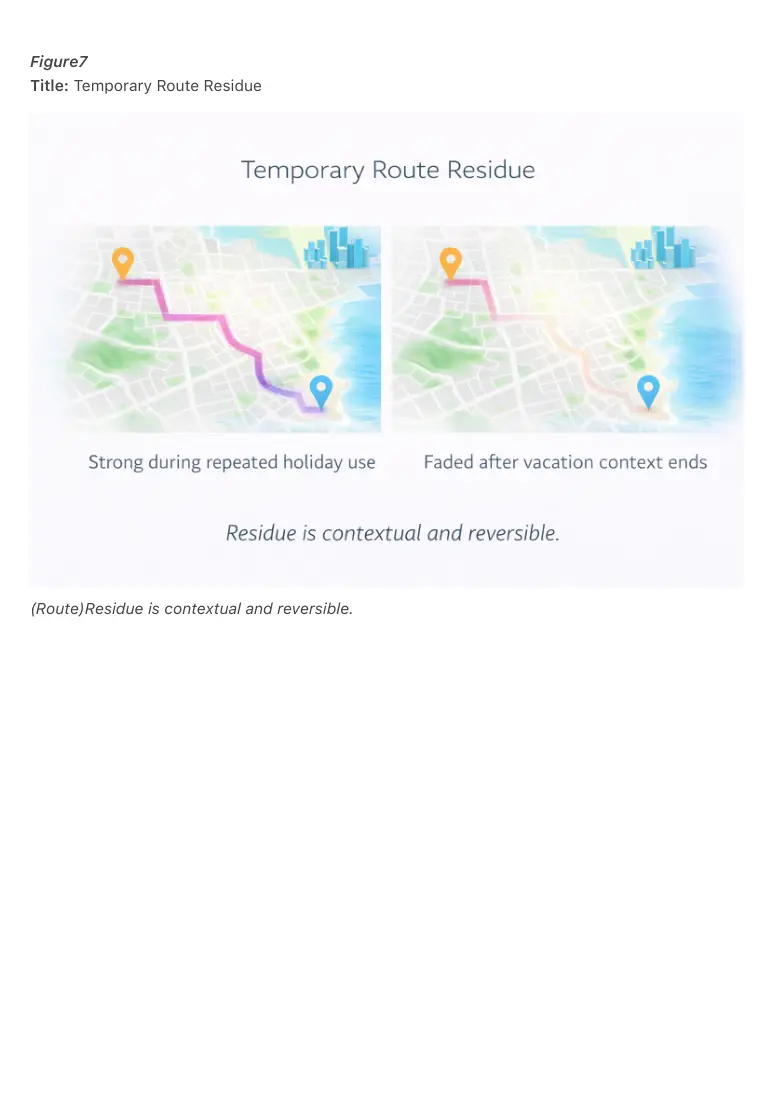
If the route is actually followed, traversal may strengthen its temporary chromatic residue.
For example:
• a holiday route driven several times becomes stronger
• a temporary beach route glows more strongly over a weekend
• a shopping or care route becomes momentarily more legible through
repeated use
• a household path for walking a dog gains temporary stability
But this residue is not permanent storage. It is contextual.
When the holiday ends, the route fades.
When the situation is over, the attractor weakens.
When no attention returns, the residue dissolves.
This makes route memory reversible and humane.
The system therefore avoids both extremes:
• total disappearance
• endless symbolic accumulation
⸻
7. Attractor coloring
This model also changes the map itself.
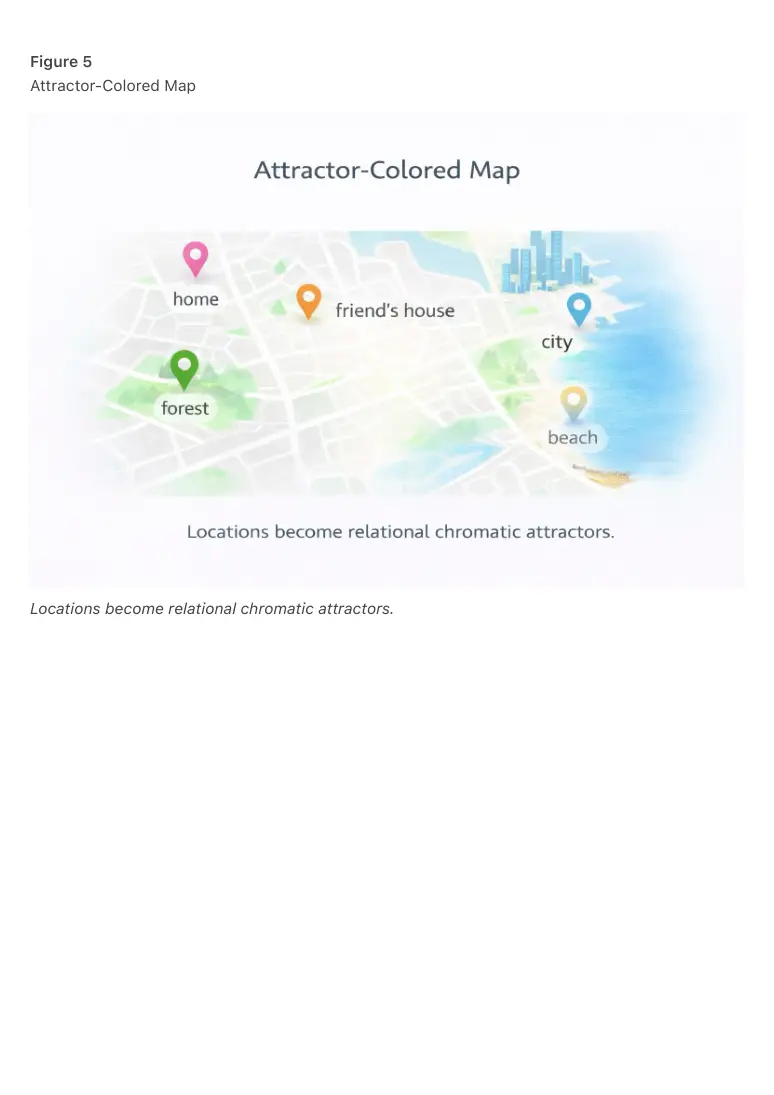
Places need not remain neutral labels. They may become self-assigned chromatic attractors.
Examples:
• shared home = warm red
• friend’s house = pink
• beach = beige + light blue
• forest = pine green
• shopping district = blue-orange
• city node = gray-purple
PDF page 9
• care location = green-red or green-blue
• station = purple-blue
This makes navigation relational rather than only geometric.
If a wife sends a chromatic message, its meaning may be read faster if the message
resonates with already-known attractor colors. The map therefore becomes not just
a topological surface, but a living chromatic field of relations, places, and temporary
intention.
⸻
8. Wearables, objects, and infrastructure
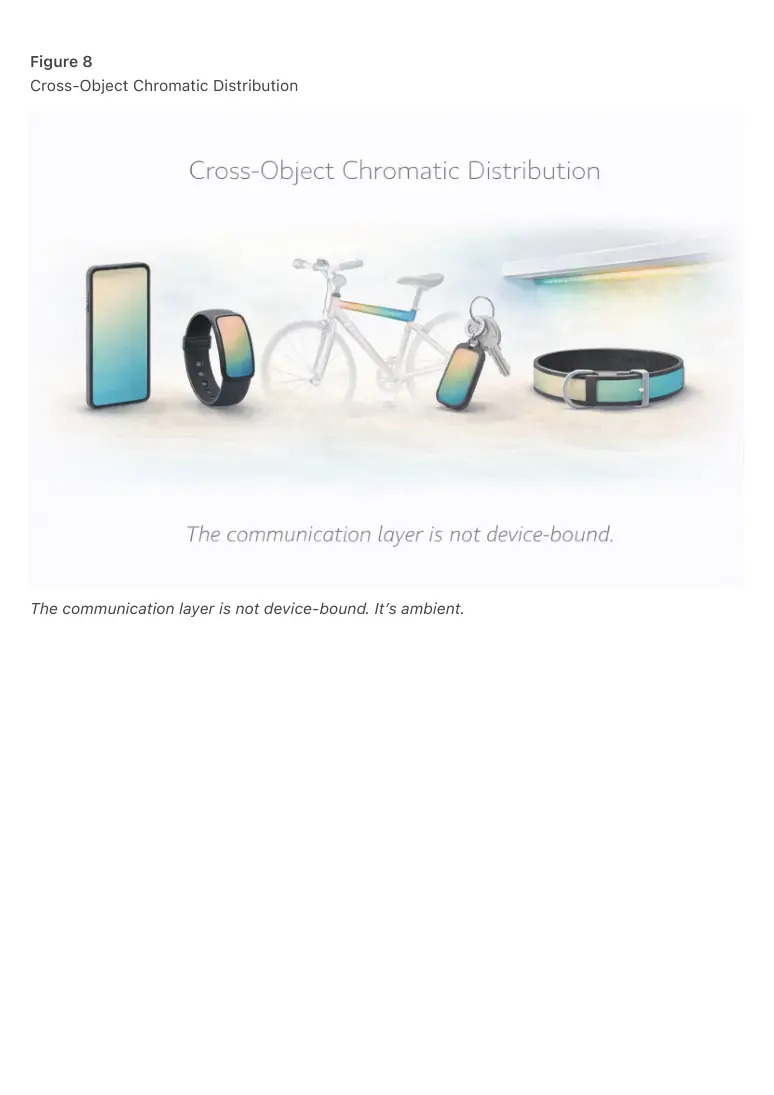
A chromatic message-to-route system is not tied to one device.
The same message may be distributed across:
• phone
• smartwatch
• wristband
• bike strip
• dog collar
• keyfob
• necklace
• shoelace module
• home light strip
• vehicle display
• public sign
• station interface
This means the communication substrate is object-agnostic.
Color is the transferable layer.
A dog-collar may carry a care-state.
A bike strip may carry a route-state.
A wristband may carry a social proposal.
A keyfob may carry home-state.
A household strip may carry a shared landing condition.
The same chromatic message can therefore travel across everyday life without
needing to remain trapped in a single screen.
PDF page 10
Public life already depends heavily on color-coded infrastructure, from traffic lights
to transit signaling and civic wayfinding. What this model adds is not color in
general, but state-first, grammatical color sequences that can move between
persons, objects, navigation, and infrastructure while preserving semantic shape.
That is what makes the layer infrastructural rather than merely decorative.
⸻
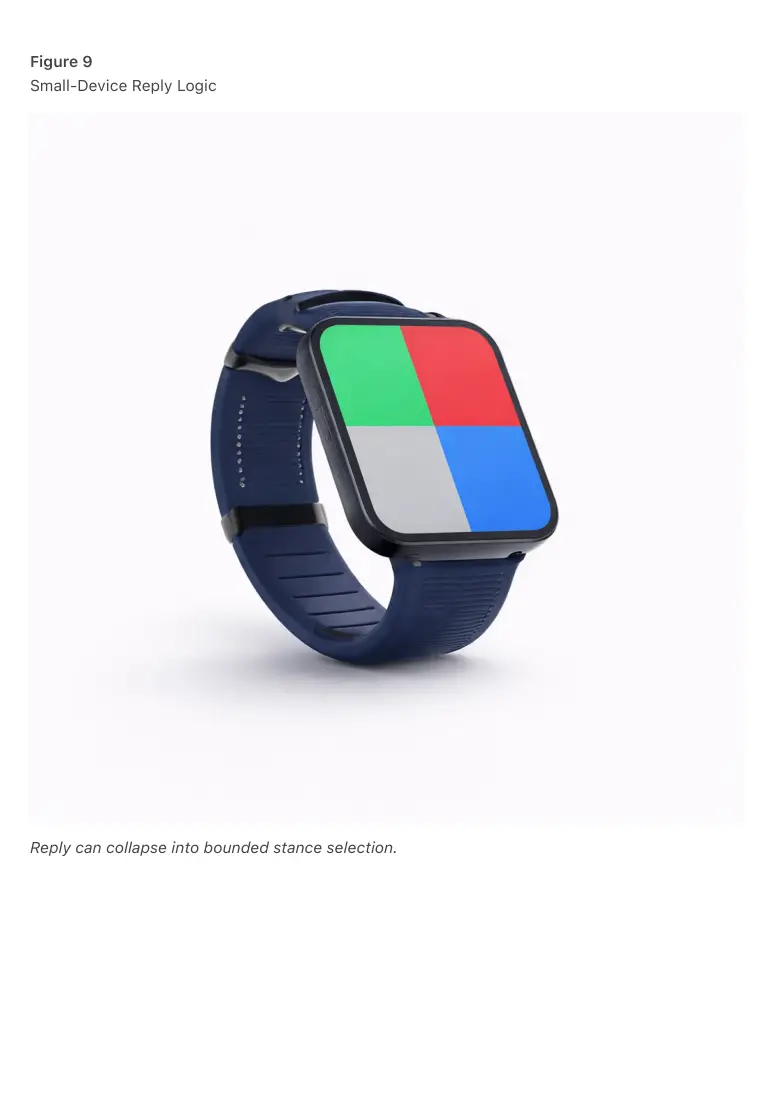
9. Small-device replies
On very small devices, reply does not require full message composition.
Incoming communication may be rich.
Reply may be bounded.
A small wearable may offer only four reply states:
• green = yes / accepted / stable
• red = no / stop / not okay
• gray = unsure / later
• blue = question back / more info
The user selects a stance, and AI reconstructs the likely full reply if needed.
Thus:
• incoming message = full chromatic sentence
• outgoing reply = bounded stance
• AI performs sentence reconstruction downstream
This preserves speed and glanceability while making the system practical for very
small objects.
⸻
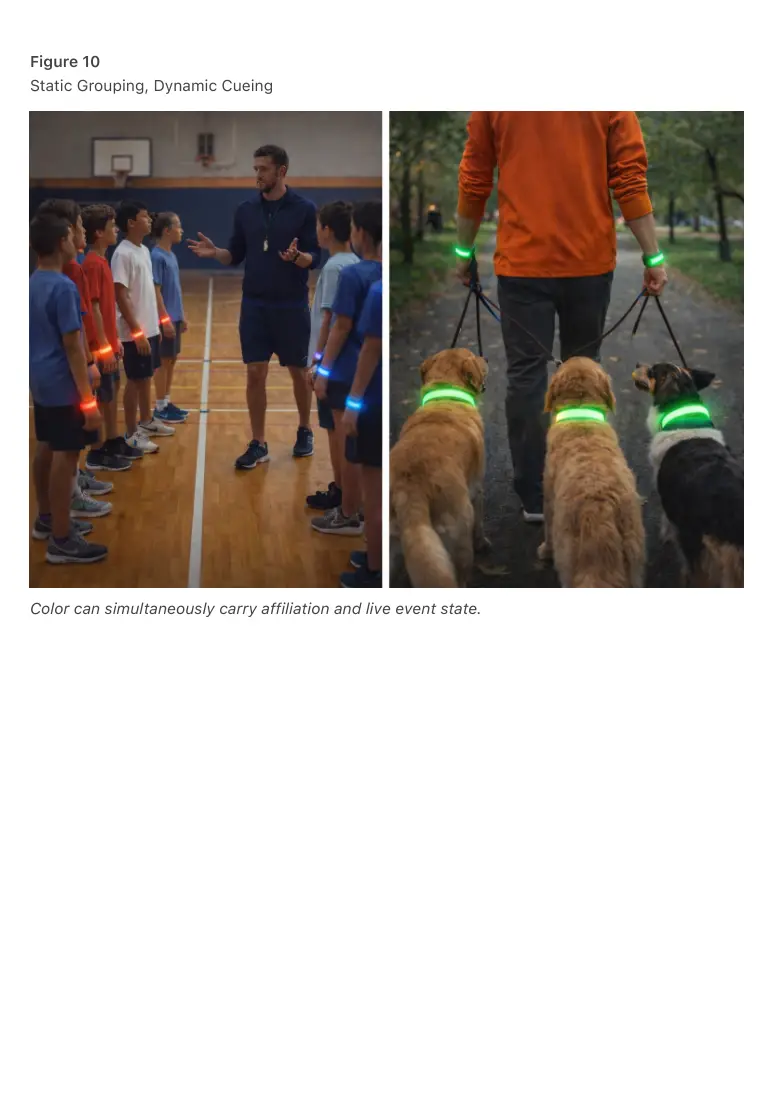
10. Static grouping and dynamic cueing
Color can also operate in two simultaneous regimes.
PDF page 11
10.1 Static color
Static color indicates:
• team
• household
• running group
• friend cluster
• sports side
• pack affiliation
10.2 Dynamic color
Dynamic color indicates:
• event
• role
• transition
• warning
• message
• sync cue
• task change
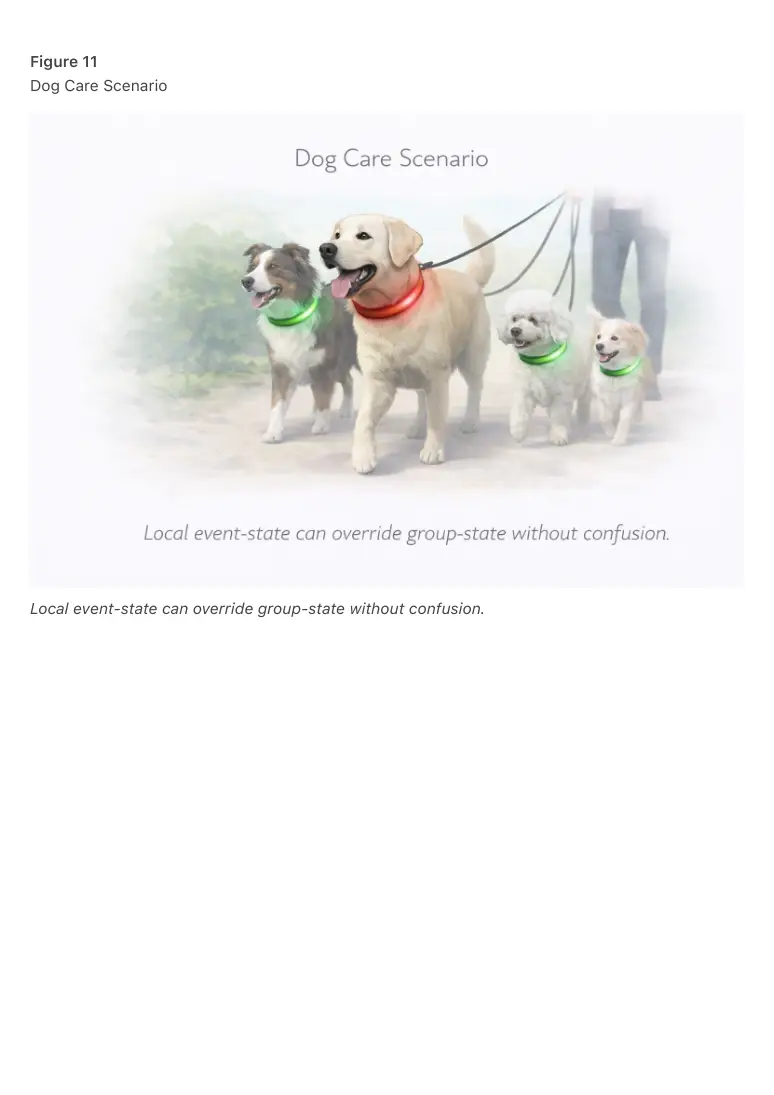
Example:
• three dogs and one human belong to the green group
• one dog receives a red care cue
• the group remains green
• one member carries a new local state
Or:
• gym class starts with red and blue teams
• one player fades to gray when out
• one player shifts to yellow when a new sub-team emerges
• one player receives a brighter modulation when becoming leader
This allows color to carry belonging and event simultaneously.
Static color groups.
Dynamic color speaks.
⸻
PDF page 12
11. Reversibility, ambient power, and non-capture
Chromatic systems become humane only when color remains reversible.
A chromatic state must not harden into fixed identity, permanent ownership, or ideological
classification. A color may indicate temporary relevance, local coordination, relational proximity,
or contextual pressure, but it must not imprison a being inside a permanent category.
This distinction is foundational:
• chromatic state is not chromatic identity
• local relevance is not essence
• coordination is not capture
• temporary grouping is not destiny
A dog may temporarily carry a care-state.
A runner may temporarily carry a route-state.
A team may temporarily carry a shared color.
An infrastructure node may temporarily emit pressure.
An AI agent cluster may temporarily display affiliation or load.
But none of these states should be treated as permanent essence.
11.1 Against hard capture
Historically, visible systems of classification have often been used for domination: fixed insignia,
badges, uniforms, national codings, imposed identifiers, and ideological color assignments. In
such systems, color does not describe condition. It claims identity. It no longer helps beings
move through life. It captures them.
Chromatic communication must not repeat this logic.
Its ethical condition is reversibility:
• opt-in where possible
• situational rather than essential
• dissolvable after context ends
• local rather than totalizing
• relational rather than possessive
Color remains humane only when it can fade.
PDF page 13
11.2 Ambient power
This also changes the meaning of power.
Hard power forces.
Soft power persuades.
Ambient power carries.
Ambient power does not dominate a subject from outside, nor seduce a subject into symbolic
compliance. It creates a warm, legible, low-friction condition in which movement, coordination,
and relation become easier without coercion.
In this sense, chromatic infrastructure belongs to ambient power:
• it supports without commanding
• it clarifies without reducing
• it coordinates without imprisoning
• it remains present without becoming oppressive
Its strength lies not in enforcement, but in carried continuity.
11.3 Diffusion against ideology
Ideological systems tend to stabilize around fixed symbols, fixed identities, fixed enemies, and
fixed color assignments. They reduce reality to hard categories that demand loyalty and
repetition.
Chromatic systems become different when color diffuses.
A gradient cannot be reduced as easily as a flag.
A reversible state cannot be weaponized as easily as a permanent badge.
A contextual color-field resists the rigid simplifications on which ideology depends.
This does not make misuse impossible. But it changes the default structure.
When color remains:
• gradient-based
• contextual
• reversible
• non-essential
• non-totalizing
PDF page 14
then ideological fixation becomes harder to sustain.
In this sense, chromatic communication does not merely add another symbolic layer.
It weakens the very conditions under which fixed symbolic capture becomes
dominant.
11.4 Core ethical rule
Hard power forces. Soft power persuades. Ambient power carries.
Color must describe condition, not destiny.
A chromatic system remains humane only if its states can emerge, intensify, coordinate, and
dissolve without becoming permanent instruments of capture.
12. Chromatic grouping for AI agents
The same chromatic logic that supports people, teams, routes, animals, and public coordination
also applies to AI agents.
As soon as multiple agents operate together, a new readability problem emerges:
• which agents belong together
• which agent performs which role
• which agent is currently active
• which agent has priority
• which agent is uncertain
• which agent is overloaded
• which agent is handing work to another
• which agent belongs to which company, stack, or trust domain
What is still largely missing is a humane surface for reading such systems at first
glance.
12.1 The legibility gap
In current multi-agent systems, orchestration is usually hidden behind:
• text labels
• verbose traces
• dashboards
• logs
• hidden tool calls
PDF page 15
• backend routing
This is technically functional, but not glanceable.
As agent ecologies grow, users need to perceive not only final output, but also:
• affiliation
• role
• activity
• handoff
• confidence
• pressure
• stabilization
This paper proposes that agent orchestration is also a color problem.
12.2 Static chromatic grouping
Static color can indicate agent affiliation.
Examples:
• purple cluster = infrastructure / backend / enterprise agents
• blue cluster = knowledge / research agents
• green cluster = care / stabilisation / recovery agents
• pink cluster = relational / user-facing agents
• yellow or orange cluster = action / dispatch / routing agents
• red cluster = urgency / intervention / exception-sensitive agents
This makes it possible to read agent families without requiring persistent text labels.
12.2.1 Role grouping
Static chromatic grouping may also distinguish agent role rather than only agent affiliation.
A multi-agent field may separate:
• research
• logic
• synthesis
• execution
• routing
• care
• verification
PDF page 16
• orchestration
into distinct readable roles.
The key question is therefore not only which agents belong together, but which role
each agent stabilizes inside the field.
In this sense, chromatic grouping can separate at least two structural layers:
• base hue = company, trust domain, or agent family
• internal pattern = operational role
This makes agent readability stronger than simple identity labeling.
12.2.2 Cross-company grouping
As agent systems scale beyond a single provider, users and infrastructures must be able to
distinguish not only agent role, but also organizational affiliation and trust domain.
This becomes especially important when agents from different companies:
• exchange information
• hand off work
• negotiate uncertainty
• participate in shared completion
• remain partially autonomous while still cooperating
Chromatic grouping can separate these layers at first glance:
• base color for company or trust domain
• role pattern for operational function
• live modulation for current state
In this way, a multi-company agent ecology remains legible without collapsing into
dashboard overload.
12.3 Dynamic chromatic modulation
Above the stable grouping layer, dynamic modulation can indicate current state:
• shimmer = active research or search
• pulse = execution or dispatch
• fade = uncertainty or unresolved status
• hard red interrupt = escalation or conflict
• green landing = stable completion
PDF page 17
• gray drift = inactivity, sleep, or unresolved ambiguity
• traveling accent = handoff from one agent to another
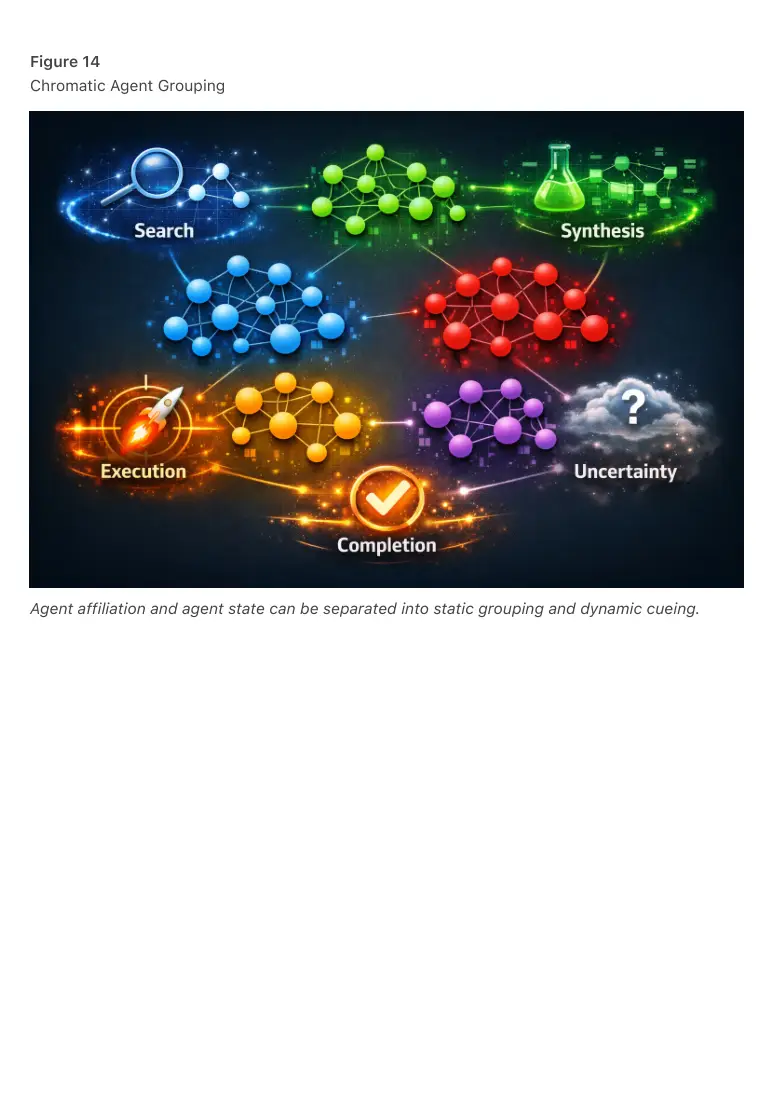
Thus:
• static color says who the agent belongs to
• internal pattern says what role the agent carries
• dynamic color says what the agent is doing now
This allows agent ecologies to remain readable under motion rather than only under
inspection.
12.4 Distributed pressure
Multi-agent systems do not only distribute function. They also distribute pressure.
Some agents:
• route
• verify
• search
• synthesize
• act
• stabilize
• escalate
• remain latent until needed
The question is not only what agents exist, but where the active burden currently
lives.
Color can make that burden legible.
Examples:
• heavy purple = infrastructural load
• active blue = research pressure
• warm orange = execution pressure
• red = conflict or instability
• green = stabilized output
• gray = unresolved or dormant state
This may be called chromatic agent pressure: a state-first observability layer for
distributed AI work.
PDF page 18
As agent systems scale across companies and devices, pressure also becomes
cross-system:
• one company may carry retrieval load
• another may carry execution load
• another may carry verification
• another may absorb uncertainty or exception handling
Chromatic pressure therefore makes not only local activity, but distributed systemic
burden, readable at first glance.
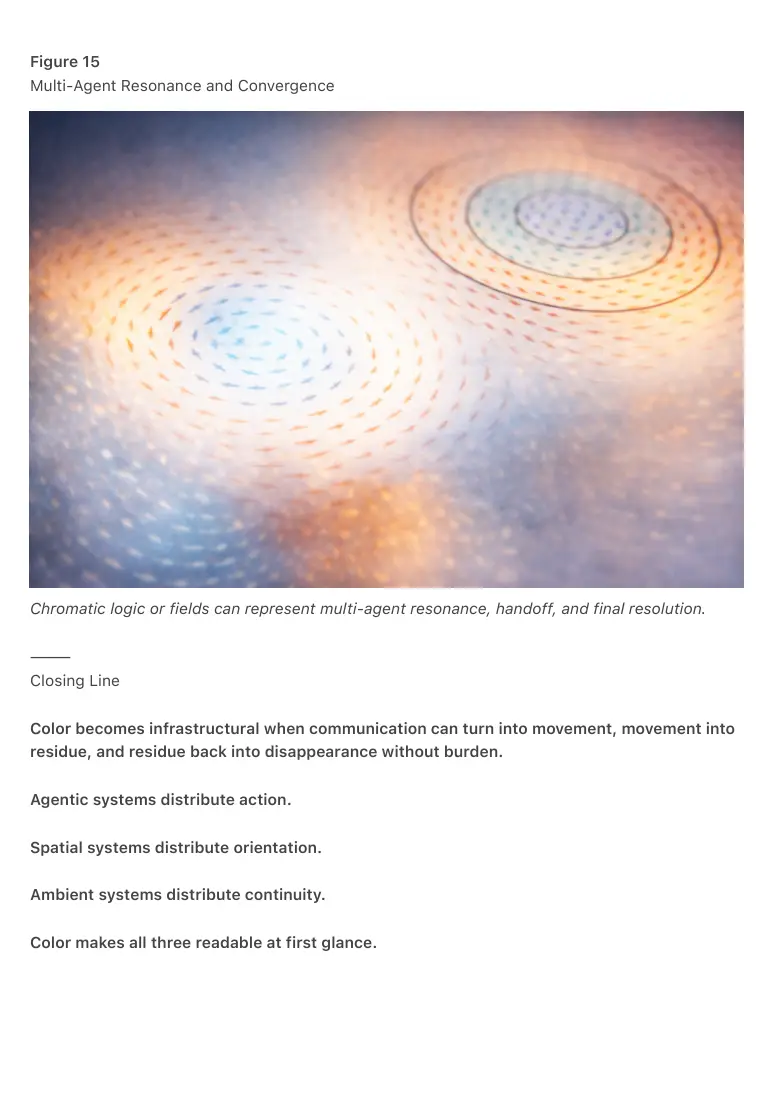
12.5 Resonance, convergence, and orchestration
In many multi-agent systems, the user does not directly inspect every internal step. Instead, the
system resolves intermediate differences and produces a final answer.
In practical terms, this often looks like:
• multiple agents diverge
• partial findings appear
• some agents resolve earlier than others
• a leading synthesis emerges
• a final result is returned to the user
This process can be understood chromatically as:
• divergence
• active grouping
• resonance
• convergence
• output stabilization
Thus chromatic grouping is not only about identity. It is also about multi-agent
resonance: the visible transition from distributed parallel work toward a coherent
result.
Beyond this, many agent ecologies also require orchestration. A leading node may
not simply be another worker among workers, but an orchestration attractor:
• coordinating handoff
• weighting partial outputs
• stabilizing conflicts
• guiding convergence
• carrying the transition from plurality to answer
PDF page 19
In this sense, a multi-agent field requires visibility not only of role and pressure, but
of orchestration.
12.6 Infrastructural agent residue
As agent systems become persistent and ambient, they do not merely perform isolated actions.
They begin to form recurring pathways, handoff habits, trust relations, verification loops, and
stabilized convergence routes across infrastructures and daily life. This creates a new kind of
residue: not symbolic memory in the classical sense, but distributed computational footprint.
This residue may include:
• repeated query pathways
• recurring handoff chains
• stable verification routes
• cross-company collaboration traces
• uncertainty zones
• convergence attractors
• completion corridors
Human residue tracks lived movement.
Agent residue tracks distributed computation in life.
In such environments, Chromatic Front becomes the first-glance surface that keeps
agent residue readable, reversible, and governable.
As chromatic residue becomes persistent enough to remain available after
stabilization, it no longer functions only as trace. It begins to function as
resource. In that sense, chromatic infrastructure is not only a legibility layer for
ambient agent ecologies, but a possible substrate for later chromatic computing.
12.7 Human-agent compatibility
The same chromatic laws used for human grouping and dynamic cueing can therefore scale into
human-agent systems.
A user could immediately perceive:
• this is my personal agent
• this is a company agent
• this is a navigation agent
• this is a knowledge agent
PDF page 20
• this is a care or safety agent
• this is a backend agent
• this is a resolving cluster
• this is an overloaded branch
without requiring full textual inspection.
In this sense, chromatic grouping is not only a human social layer.
It becomes a shared human-agent legibility layer.
This is especially important once agents move beyond chat surfaces and begin to
inhabit routes, infrastructure, devices, and ambient environments. At that point,
users need legibility without interruption.
12.8 Ambient transition
As agent systems become persistent, distributed, backgrounded, and continuously available
across devices and infrastructures, agentic computing begins to function as ambient computing
at scale.
Agentic systems distribute action.
Ambient systems distribute the condition in which action can remain carried, backgrounded, and
legible.
What begins as explicit orchestration tends, at scale, toward ambient support.
In this sense, ambient computing may be understood not as the opposite of agentic computing,
but as its distributed environmental form: agentic action carried widely enough, gently enough,
and continuously enough that it becomes ambient.
Chromatic infrastructure becomes important precisely at this threshold. It provides a first-glance
legibility layer for a world in which multiple agents, systems, and trust domains remain active
without demanding continuous textual attention.
Chromatic Front is the legibility layer that keeps recursive agent ecologies readable as they
integrate into everyday life.
PDF page 21
12.9 Core claim
If AI agents distribute work, color can distribute legibility.
Or more precisely:
Multi-agent systems need chromatic grouping the same way human groups do.
As agent ecologies scale across companies, devices, and infrastructures, chromatic systems can
separate:
• affiliation
• role
• state
• pressure
• handoff
• convergence
• residue
without collapsing into symbolic overload.
This makes chromatic infrastructure relevant not only for wearables, navigation, and
public coordination, but also for the next generation of distributed AI systems.
⸻
13. Why this matters
This model matters because the next computational environment is no longer merely textual,
app-bound, or single-agent.
It is increasingly:
• agentic
• spatial
• ambient
Agentic systems distribute action.
Spatial systems distribute orientation.
Ambient systems distribute continuity.
Chromatic infrastructure can make all three readable at first glance.
PDF page 22
This matters because future coordination will not happen only inside screens. It will
happen across:
• phones
• watches
• routes
• vehicles
• household objects
• civic infrastructure
• animal wearables
• public movement
• agent ecologies
• cross-company computational fields
As these layers multiply, users will need more than logs, labels, dashboards, and
symbolic interfaces. They will need a low-friction legibility layer capable of
separating:
• affiliation
• role
• state
• pressure
• relation
• motion
• handoff
• stabilization
• residue
without increasing burden.
That is why chromatic infrastructure is not only expressive, but infrastructural.
It provides a lighter first layer in conditions where:
• text is too slow
• symbols are too heavy
• dashboards are too dense
• movement must continue
• multiple systems must remain readable at once
This is not an argument against language.
It is an argument for a prior layer of felt legibility.
Color becomes powerful here not because it freezes meaning, but because it keeps
PDF page 23
meaning mobile.
A fixed symbolic system tends toward capture:
• fixed categories
• fixed labels
• fixed allegiances
• fixed oppositions
Chromatic infrastructure becomes different when color remains:
• contextual
• gradient-based
• reversible
• local
• non-essential
• dissolvable after use
For that reason, chromatic systems can weaken the rigid simplifications on which
ideological capture often depends. They do not erase structure. They make
structure more fluid, more reversible, and less totalizing.
This is also where ambient power differs from older models of power.
Hard power forces.
Soft power persuades.
Ambient power carries.
Chromatic infrastructure belongs to ambient power when it remains:
• warm
• legible
• reversible
• non-capturing
• situational
Its function is not to impose identity or obedience, but to carry coordination,
continuity, and relation without coercion.
In this sense, the chromatic message-to-route model matters not only as a
communication system, but as a civilizational interface principle.
It suggests that future infrastructures may become more humane when:
• communication can remain glanceable
PDF page 24
• routes can remain relational
• residue can remain temporary
• grouping can remain visible without becoming capture
• agents can remain legible without becoming oppressive
• action can remain distributed without becoming unreadable
• ambient agent ecologies can remain governable without becoming opaque
This is why color matters here.
Not as decoration.
Not as mood styling.
Not as ideology.
But as the first infrastructural layer through which distributed life can remain
readable.
⸻
14. Conclusion
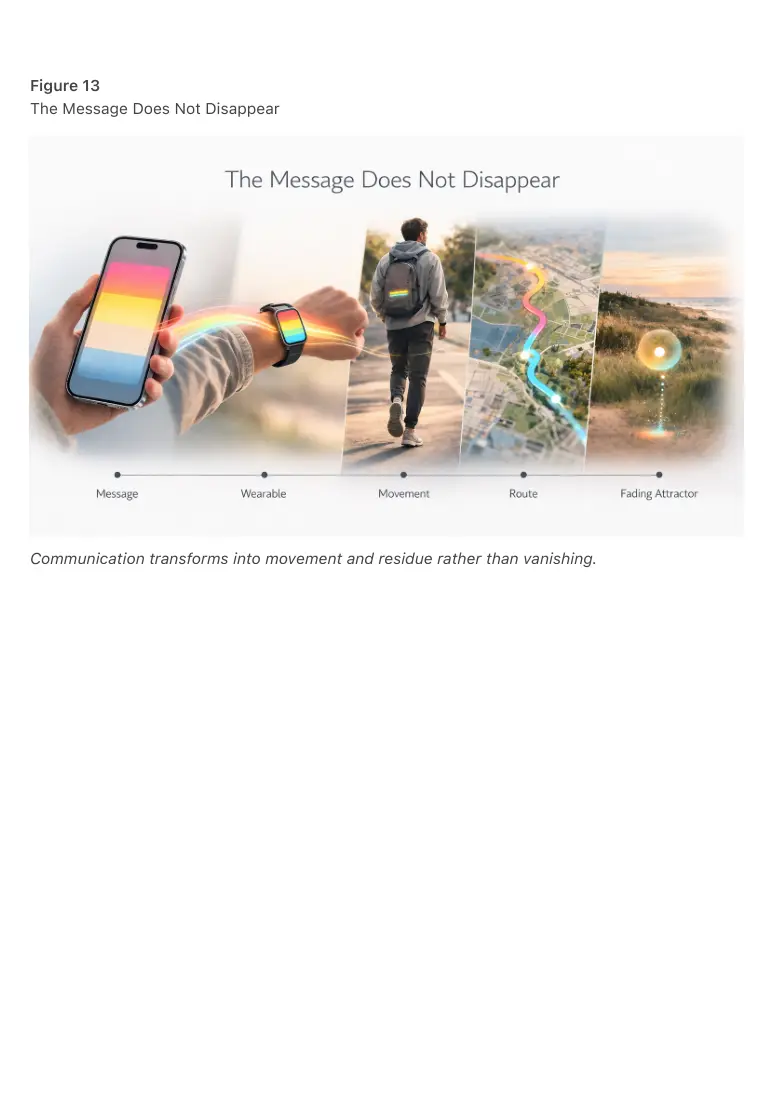
The central claim of this paper is that a chromatic message can become movement.
Rather than treating communication, routing, and residue as separate systems, this model
proposes a continuous chromatic chain in which:
• a message is received as a state-sequence
• the sequence is accepted
• the sequence becomes route
• traversal builds temporary residue
• the residue fades when the situation is over
This creates a humane communication substrate for life in motion.
It is lightweight enough for wearables, rich enough for social coordination, and
scalable enough for ambient infrastructure.
In this sense, chromatic communication is not only messaging.
It is:
• communication
• navigation
• grouping
• route memory
• temporary attractor formation
PDF page 25
• ambient coordination
• and, increasingly, agent legibility
all carried by one medium.
The same chromatic logic that supports people in motion can also support
distributed AI systems. As agent ecologies grow, color can provide the missing
legibility layer for affiliation, role, pressure, handoff, resonance, and completion. In
that sense, chromatic infrastructure is not limited to human communication. It also
becomes a shared grammar through which humans, agents, animals, and
infrastructure remain mutually readable. Contemporary xAI documentation on
realtime multi-agent research makes this extension practical rather than
hypothetical.
The message does not disappear.
It becomes movement.
PDF page 26
Figures
Figure 1
Chromatic Message-to-Route Model
The core model is a continuity system, not separate functions.
PDF page 27
Figure 2
Wearable Message in Motion
communication remains readable while life continues.
PDF page 28
Figure 3
Example Chromatic Sentence
Chromatic communication can carry structured meaning.
PDF page 29
Figure 4
Message to Route
Accepted messages can collapse into navigation
PDF page 30
Figure 5
Attractor-Colored Map
Locations become relational chromatic attractors.
PDF page 31
Figure 6
Field-presence

PDF page 32
If a chromatic message collapses into route, the target can be felt as experience before arrival.
PDF page 33
Figure7
Title: Temporary Route Residue
(Route)Residue is contextual and reversible.
PDF page 34
Figure 8
Cross-Object Chromatic Distribution
The communication layer is not device-bound. It’s ambient.
PDF page 35
Figure 9
Small-Device Reply Logic
Reply can collapse into bounded stance selection.
PDF page 36
Figure 10
Static Grouping, Dynamic Cueing
Color can simultaneously carry affiliation and live event state.
PDF page 37
Figure 11
Dog Care Scenario
Local event-state can override group-state without confusion.
PDF page 38
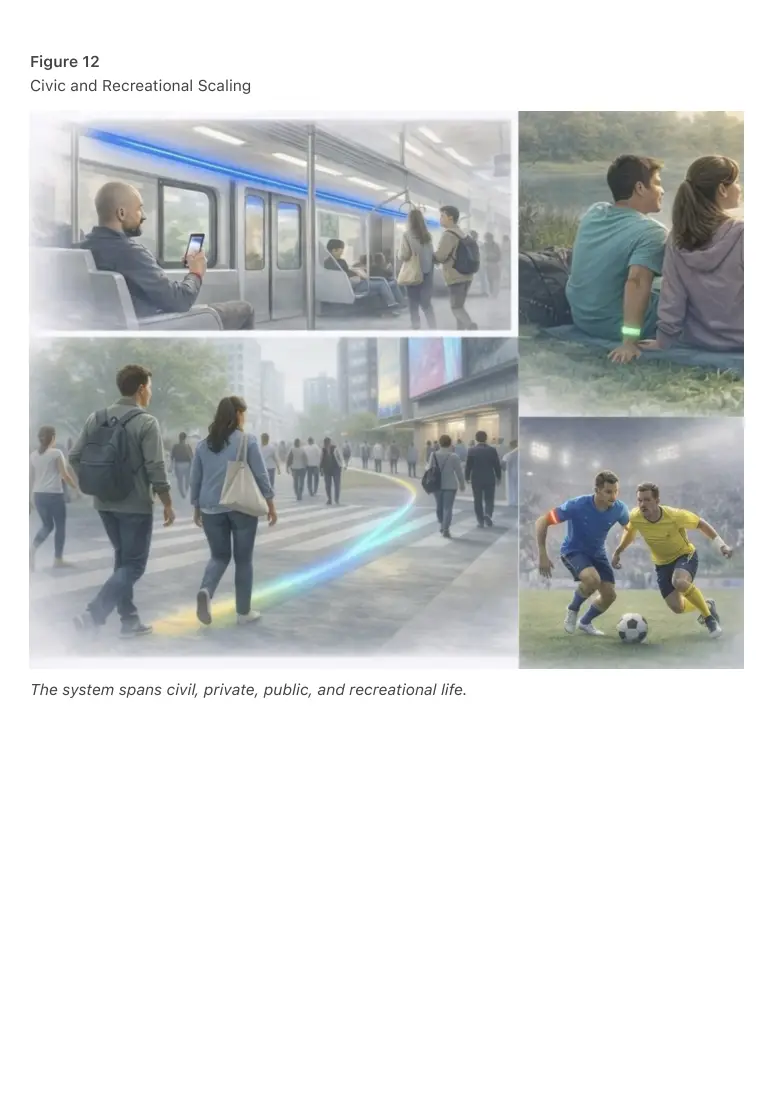
Figure 12
Civic and Recreational Scaling
The system spans civil, private, public, and recreational life.
PDF page 39
Figure 13
The Message Does Not Disappear
Communication transforms into movement and residue rather than vanishing.
PDF page 40
Figure 14
Chromatic Agent Grouping
Agent affiliation and agent state can be separated into static grouping and dynamic cueing.
PDF page 41
Figure 15
Multi-Agent Resonance and Convergence
Chromatic logic or fields can represent multi-agent resonance, handoff, and final resolution.
⸻
Closing Line
Color becomes infrastructural when communication can turn into movement, movement into
residue, and residue back into disappearance without burden.
Agentic systems distribute action.
Spatial systems distribute orientation.
Ambient systems distribute continuity.
Color makes all three readable at first glance.